
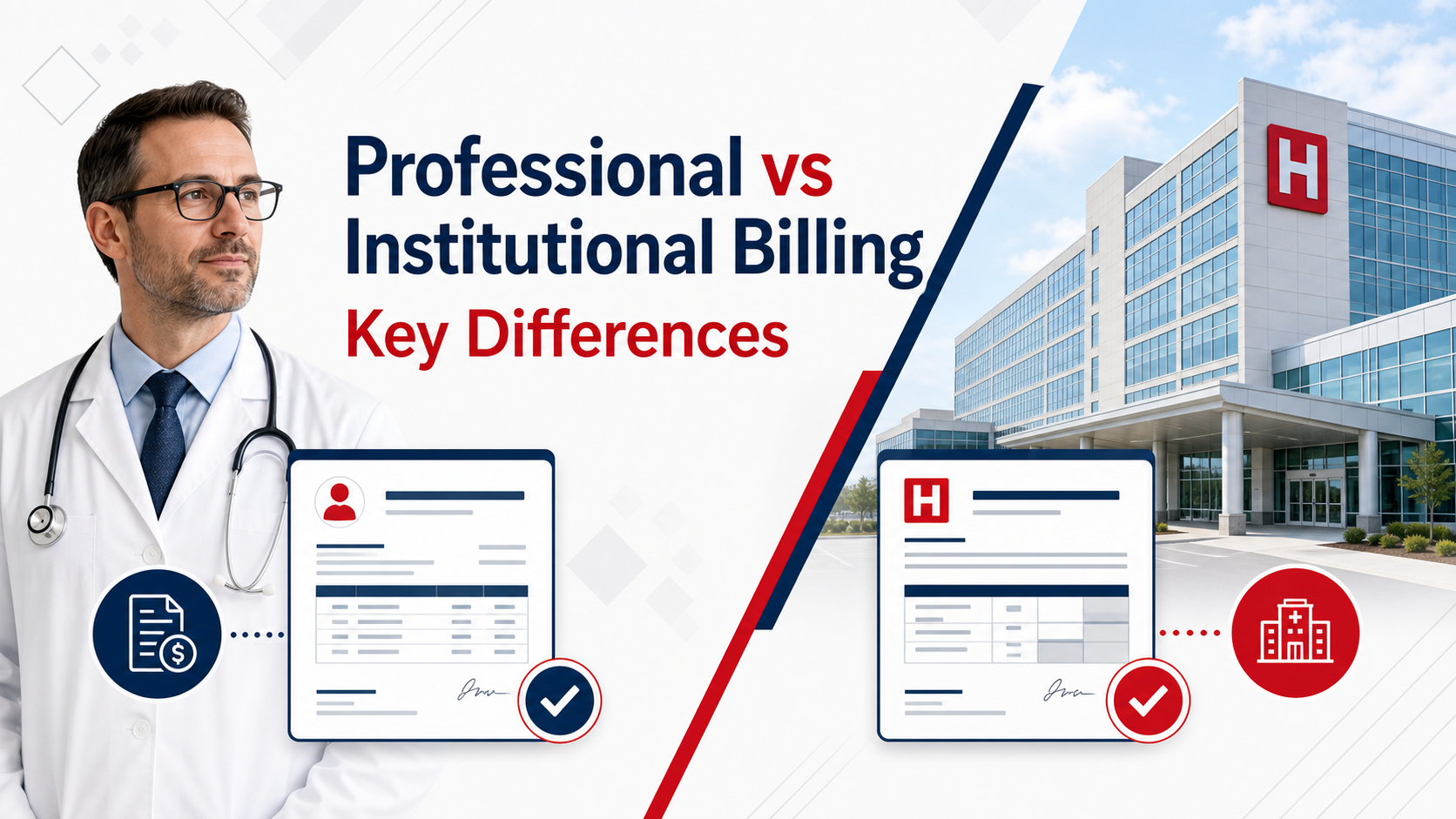
Direct answer: Professional billing reports services provided by physicians and other eligible practitioners, usually through the electronic 837P transaction or the paper CMS-1500 form. Institutional billing reports services provided by hospitals and other facilities, generally through the electronic 837I transaction or the paper CMS-1450, also called the UB-04.
Last reviewed: October 2026. This guide provides general billing information. Requirements can vary by payer, provider type, facility, service, and contract.
Professional Billing vs. Institutional Billing
Professional and institutional claims describe different parts of healthcare delivery. The correct claim type depends on who furnished the service, which organization is billing, the care setting, the provider’s enrollment, and the payer’s requirements.
A physician may provide care inside a hospital while the hospital and physician submit separate claims. The facility may submit an institutional claim for its resources, while the physician or physician group submits a professional claim for the practitioner’s services.
| Feature | Professional Billing | Institutional Billing |
|---|---|---|
| Electronic format | 837P | 837I |
| Paper form | CMS-1500 | CMS-1450 or UB-04 |
| Typical biller | Physician, practitioner, group, or other non-institutional supplier | Hospital or another eligible institutional provider |
| Primary focus | Practitioner services | Facility services and resources |
| Common data elements | Procedure codes, diagnosis codes, modifiers, place of service, rendering and billing provider information | Type of bill, revenue codes, diagnosis and procedure information, condition codes, occurrence codes, value codes, and facility information |
| Payment method | Depends on the payer, contract, fee schedule, service, and payment policy | Depends on the facility, setting, payer, prospective payment system, contract, and service |
What Is Professional Billing?
Professional billing is used for services furnished by physicians, qualified healthcare practitioners, and certain suppliers. Examples may include office visits, consultations, diagnostic interpretations, procedures, therapy services, and other practitioner work.
Electronic professional claims use the 837P format. When an approved exception permits a Medicare paper claim, the CMS-1500 form is used. CMS identifies the CMS-1500 as the standard paper claim form for non-institutional providers and suppliers.
A professional claim commonly includes:
- Patient and insured information
- Billing, rendering, referring, or ordering provider information when required
- National Provider Identifier information
- Dates and places of service
- ICD-10-CM diagnosis codes
- CPT or HCPCS procedure codes when applicable
- Modifiers supported by the service and documentation
- Units, charges, and prior authorization information when required
The billing team must match the claim to the practitioner’s enrollment, the documented service, the care setting, and the payer’s current instructions.
What Is Institutional Billing?
Institutional billing is used by hospitals and other eligible facilities to report covered facility services. Electronic institutional claims use the 837I format. The corresponding paper form is the CMS-1450, commonly called the UB-04.
An institutional claim can include information such as:
- Type of bill
- Patient status
- Admission, discharge, and statement dates
- Revenue codes
- Diagnosis and procedure information
- Condition, occurrence, and value codes when applicable
- Charges, units, and service dates
- Attending, operating, and other provider information when required
The exact data depends on the facility, service, payer, and payment system. Inpatient and outpatient institutional claims do not use identical coding and payment rules.
CMS-1500 and 837P Professional Claims
The CMS-1500 and 837P carry professional claim information in paper and electronic formats. Most Medicare claims must be submitted electronically unless an applicable exception permits paper submission.
The claim should accurately identify the service, diagnosis, patient, provider, place of service, and other required information. A technically valid transaction can still be denied when the service does not satisfy coverage, coding, documentation, authorization, enrollment, or payer requirements.
Practices should review clearinghouse acknowledgements as well as payer responses. An accepted electronic transaction only confirms that the file passed specified submission checks; it does not guarantee payment.
CMS-1450, UB-04, and 837I Institutional Claims
CMS-1450 and UB-04 are two names commonly used for the institutional paper claim form. The 837I is its electronic claim counterpart.
Institutional billing requires facility-specific information that does not appear in the same way on a professional claim. Revenue codes help organize facility charges, while type-of-bill information identifies the facility category, care setting, and claim frequency.
Institutional claims may also require information related to an admission, discharge, occurrence, condition, or value. Billing staff should follow the instructions applicable to the provider type and payer instead of treating every UB-04 claim as identical.
Can One Patient Encounter Produce Both Claims?
Yes. One encounter can generate both professional and institutional claims when separate practitioner and facility services are billable.
For example, a patient may receive an imaging service at a hospital. Subject to the payer’s rules and the organization’s billing arrangement:
- The facility may report the equipment, technical resources, and related facility service on an institutional claim.
- The interpreting practitioner may report the professional service on a professional claim.
Modifiers such as professional component and technical component modifiers may apply in appropriate circumstances. Their use depends on the service, code, payer policy, and documentation. Billing teams should confirm current coding instructions before submitting the claim.
Important Coding Differences
Diagnosis coding
Both professional and institutional claims can use ICD-10-CM diagnosis codes. The diagnoses reported must be supported by the medical record and follow the coding rules applicable to the setting.
Procedure coding
Professional claims commonly use CPT and HCPCS codes. Hospital outpatient institutional claims may also report CPT or HCPCS codes when required. Hospital inpatient procedure reporting can involve ICD-10-PCS under the applicable inpatient coding rules.
Revenue codes
Revenue codes are associated with institutional claims and classify facility services or accommodations. A revenue code does not replace every other coding requirement. The claim may also need an appropriate procedure code, units, charges, and supporting clinical information.
Payment classifications
Payment methods vary. Professional services may be paid under a fee schedule or contract-specific methodology. Institutional services may be paid through inpatient, outpatient, per-diem, case-rate, or other systems. The applicable payer policy and contract control the actual calculation.
Common Professional Claim Problems
- Incorrect place-of-service information
- Rendering or billing provider enrollment mismatch
- Missing or unsupported modifier
- Diagnosis and procedure mismatch
- Missing authorization or referral information
- Duplicate or incorrectly identified corrected claim
- Missing documentation requested by the payer
Common Institutional Claim Problems
- Incorrect type of bill or claim frequency
- Revenue-code and procedure-code inconsistency
- Missing condition, occurrence, or value code
- Admission, discharge, or patient-status inconsistency
- Incorrect units or service dates
- Authorization or notification failure
- Incomplete facility or attending-provider information
How to Choose the Correct Claim Type
Before submitting a claim, confirm:
- Who is billing? Determine whether the billing entity is enrolled as a practitioner, supplier, facility, or another provider type.
- What service was furnished? Review the documentation and identify the professional and facility components.
- Where was the service provided? The care setting can affect the claim format, place of service, payment, and coding.
- Which payer rules apply? Medicare, Medicaid, commercial plans, and other payers can have different billing instructions.
- Is the provider correctly enrolled? Confirm billing, rendering, attending, referring, or ordering-provider requirements.
- Does the claim match the record? Codes, modifiers, dates, units, and provider information must be supported by documentation.
Claim Review Checklist
- Confirm whether the claim should be professional or institutional.
- Use the current electronic transaction or approved paper form.
- Verify patient eligibility and payer information.
- Confirm provider and facility enrollment.
- Check diagnosis, procedure, revenue, and modifier information.
- Verify dates, units, charges, and place or type of service.
- Review authorization and referral requirements.
- Check clearinghouse acknowledgements and payer responses.
- Correct rejected claims before resubmission.
- Use the payer’s corrected-claim or appeal process when applicable.
How Billing Support Can Help
A consistent workflow helps healthcare organizations route claims correctly, review submission errors, post remittances, investigate unpaid balances, and follow payer requirements.
Med Billing & Transcription provides medical billing and coding support, revenue cycle management, denial follow-up, and credentialing support. Services are adapted to the organization’s workflow and payer mix.
Contact our team to discuss professional or institutional billing support.
Frequently Asked Questions
Is the CMS-1500 used for institutional billing?
No. The CMS-1500 is the professional paper claim form. Institutional paper claims use the CMS-1450, also called the UB-04.
What is the difference between 837P and 837I?
The 837P is the electronic professional claim transaction. The 837I is the electronic institutional claim transaction.
Do hospitals submit only institutional claims?
Hospitals generally submit institutional claims for facility services, but a related practitioner service may be reported separately on a professional claim depending on the arrangement and payer rules.
Are revenue codes used on professional claims?
Revenue codes are associated with institutional billing. Professional claims instead rely on the data elements required for the 837P or CMS-1500 format.
Does an accepted electronic claim guarantee payment?
No. Acceptance confirms that the transaction passed specified submission checks. The payer can still deny or adjust the claim based on coverage, coding, documentation, enrollment, authorization, contract, or payment rules.
Official Resources
- CMS: Medicare Billing—837P and CMS-1500
- CMS: Professional Paper Claim Form
- CMS: CMS-1450 and 837I Institutional Billing
- CMS: Medicare Claims Processing Manual
- CMS: Healthcare Payment and Remittance Advice
Disclaimer: This article is for general educational and operational purposes. It is not legal, coding, reimbursement, or compliance advice. Verify current requirements with the applicable payer, official coding resources, contracts, and qualified advisors.